Blog
October 2026 · 6 min read
Tech resilience

Are your RTOs realistic?

Your RTO says 4 hours. Your real recovery chain says 7. Most organizations find out during the incident. Here's how to check before it.

The short answer

An RTO is realistic when everything the service depends on recovers within it, in sequence. Compare the service's recovery time objective with the RTOs and the tested recovery times of each dependency, including your vendors' response times. Any dependency with a longer target or a slower tested recovery is a gap to resolve.

A question from a customer

"How can I see whether our recovery objectives even make sense?" A customer asked us this, and it was such a good question that it became a feature.

Most recovery time objectives are set one service at a time, in a business impact analysis or a DR plan. Each number looks reasonable on its own. Nobody checks whether the numbers fit together along the chain a service depends on.

Three ways an RTO breaks

  1. The targets don't match.
    The service must be back in 6 hours, but a process it depends on has a 10-hour recovery target.
  2. The capability doesn't match.
    The backend has a matching 6-hour target, but it takes 10 hours to recover in practice.
  3. The vendor doesn't match.
    Your service provider picks up the ticket after 12 hours, still within its agreed 24-hour response time. By then your own target has passed.

All three stay invisible as long as each RTO lives in its own document.

What it looks like along one chain

Here is an illustrative example for a mobile banking service with a 6-hour RTO:

Dependency RTO Tested recovery time What doesn't add up
Transaction history retrieval 12 hours 14 hours Target 6 hours too long, recovery 8 hours too slow
Account balance and statement inquiry 10 hours Not recorded Target 4 hours too long, no test evidence
Customer login and authentication 10 hours 2 hours Target too long, capability fine
Mobile banking backend 6 hours 10 hours Target fits, recovery 4 hours too slow
Card management and controls 6 hours 8 hours Target fits, recovery 2 hours too slow
Cloud production region 4 hours Not recorded Target fits, no test evidence

The service RTO of 6 hours is fiction until those rows are resolved. Login shows a second kind of gap: the capability is there, and the target was never updated to match it.

Restore time is only part of recovery time

A recovery estimate often covers the restore and nothing else. A four-hour restore usually assumes working access and a prepared environment. The business waits for the whole chain: detecting the problem, deciding to invoke recovery, waiting for the vendor, restoring, validating the data and handing the service back to the people who use it.

Check the RTO against the maximum tolerable period of disruption, or the impact tolerance if you work in financial services. The RTO has to sit inside it with room to spare, because the recovery chain runs in sequence.

You don't need perfect data to start

The gaps tell you where to ask questions. A missing recovery time means nobody has tested it. A target that is longer than the service it supports means two teams set numbers without talking. Each gap tells you what to validate and who to bring into the room.

Fix it, or decide to accept it

Every gap has four ways out:

  • Shorten the dependency's recovery, for example with a warm standby.
  • Change the vendor contract or the escalation path.
  • Add a workaround that extends the time the business can wait.
  • Revise the target, with the business owner signing off on the consequence.

Then test what the change buys you. If you cut a dependency's recovery time from eight hours to four, does the minimum service come back before the workarounds run out?

A practical way to begin

  1. Pick one critical service and write down its RTO.
  2. List its dependencies, layer by layer, with their own RTOs.
  3. Add the tested recovery times from DR tests and past incidents. Mark every missing value.
  4. Add vendor response and restore times from your contracts.
  5. Flag every dependency that is slower than the service RTO, and give each gap an owner.

How we do this in resimate

The RTO feasibility view in resimate puts recovery objectives and recorded recovery times side by side along the whole dependency chain of a service, third parties included. It shows where targets conflict, where tested recovery is too slow and where evidence is missing. Every RTO gets checked against the real recovery chain, and the gaps feed straight into the Impact-Preparedness Matrix. Teams go live in 4 to 6 weeks, on the data they already have.
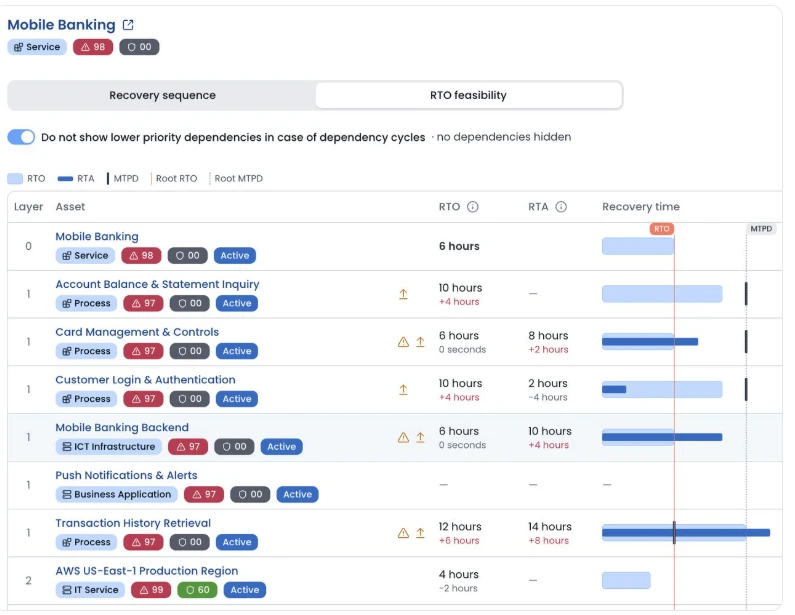
resimate RTO feasibility view comparing recovery objectives with tested recovery times for a mobile banking service

FAQ

What is the difference between RTO and RTA?

The recovery time objective (RTO) is the target. The recovery time actual (RTA) is how long recovery took in a test or a real incident. The difference between them is a capability gap.

What is the difference between RTO and RPO?

The RTO says how quickly a service must be back. The recovery point objective (RPO) says how much data loss is acceptable, measured in time.

How do you set a realistic RTO?

Start from how business impact grows over time and set the RTO inside the maximum tolerable period of disruption. Then check it against the dependency chain. Where the two disagree, invest in the capability or change the target with the business owner's sign-off.

Should dependencies have shorter RTOs than the service they support?

Yes, for the dependencies that must run before the service can start. The whole sequence, including validation and handover, has to fit inside the service RTO.

How often should RTOs be tested?

At least once a year for critical services, and after every major change to the architecture or a key supplier.
Author
Patrick Lechner is co-founder of resimate. He has 15 years of experience building and running cyber resilience and crisis management capabilities, as a Big4 Director and as VP, Head of IT and Security, with crisis work across cyber incidents, financial crises and humanitarian emergencies. He works side by side with resilience teams in financial services, critical infrastructure and technology, and that work is still the best part of his week.
Questions? Feedback?
We would love to hear from you. Please do not hesitate to contact us.

More resilience insights

Business continuity
6 min read

How do operational resilience and BCM teams use resimate?

BIAs and continuity plans are static documents, out of date soon after sign-off. Here's how the same work becomes dynamic: driven by your data, current when dependencies change, and tested.
Resilience strategy
6 min read

How do risk and compliance teams use resimate?

Regulators ask for critical functions, tolerances, tests and evidence. Most of it already exists in your organization, spread across spreadsheets, exports and plans. Here's how it becomes evidence you can stand behind.
Operational resilience
7 min read

What makes a good operational resilience program?

Most resilience programs produce documents nobody opens during an incident. The good ones build a shared, current picture of how the business works, and use it to decide what to fix first.
Tech resilience
7 min read

How do you decide what to recover first after a major outage?

The database came back first. The application needed identity first. Nobody had the order written down. A recovery sequence built from real dependencies avoids the second restart.
Business continuity
6 min read

What makes a good business continuity plan?

Business continuity plans done the old way have one thing in common: nobody opens them when something breaks. The plans people use look different.